
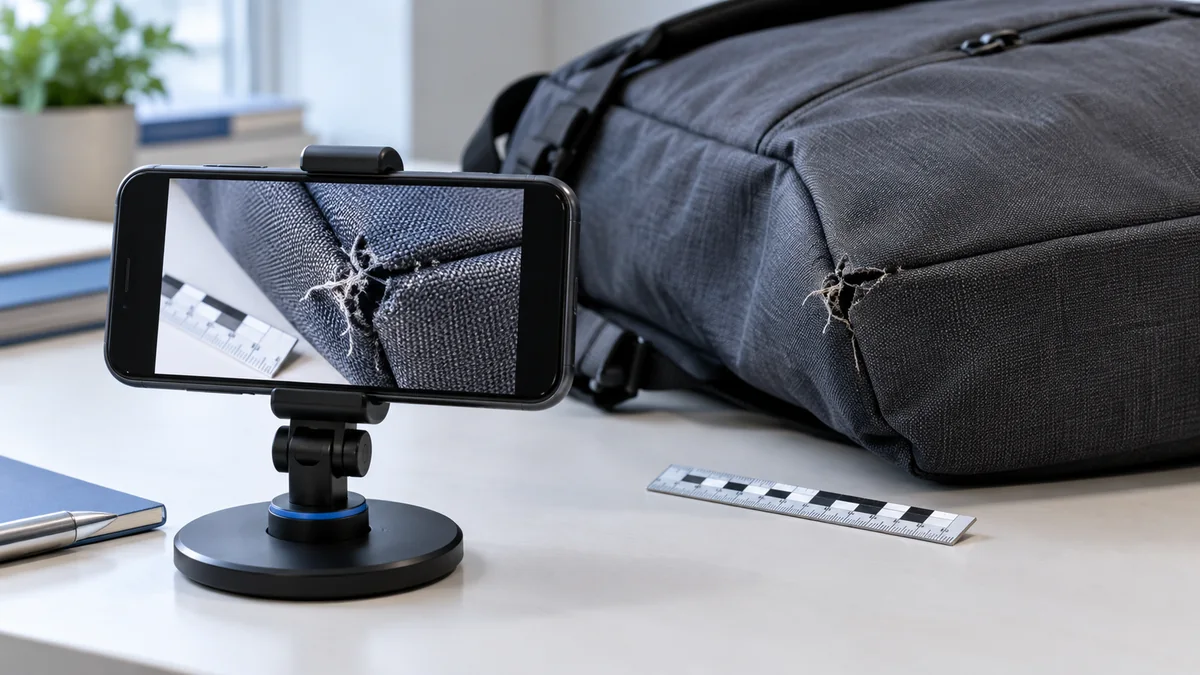
First, preserve the condition and information about the item
Good documentation answers three questions: what exactly the product is, what happened to it, and what condition it was in at a certain stage. One close-up shot of a crack rarely provides all this information. A general view, linking the damage to a specific place, and accompanying documents will be needed.
If signs of danger are detected — for example, the smell of burning, insulation damage, or failure of a load-bearing element — stop using it and follow the manufacturer's instructions. Do not turn on the device or load the damaged structure for a more impressive video.
If possible, postpone repairs, cleaning with aggressive substances, disassembly, and other changes until the inspection is agreed upon. If urgent actions are required for safety or to reduce further damage, first document the original condition if it is safe, and then record the details of the actions taken.
Shoot from the general view to the details
- General view. Film the product entirely and from several sides. For shoes, show both halves of the pair; for a furniture set — show the mutual arrangement of the elements.
- Identification. Separately remove the label, model, article number, and serial number, if provided. The information should allow linking the photos to the item being submitted.
- Place of the defect. Show the area together with adjacent elements, so that its position is clear: corner of the front, fastening area, seam or sole section.
- Detail. Take a sharp close-up photo in even lighting. If necessary, use several angles. A glare can hide a crack, and a shadow can create the impression of damage.
- Scale and comparison. Place a ruler nearby without covering the damage. If comparing symmetrical parts, photograph them under similar conditions and at the same distance.
A photo with a ruler helps to roughly convey the size, but by itself does not replace measurement: perspective, scale position, and optical distortions affect the result. Do not declare the exact size of the defect based solely on such a shot.
When video is useful
Video is suitable for manifestations that are difficult to show in a single shot: play, mechanism sticking, uneven movement, or intermittent operation. Start with an overall view and identification of the object, then show the usual sequence of actions and the observed result. Try not to stop recording at a key moment.
Separately record the conditions: mode, load, operating time, used accessories. Do not simulate a malfunction or create conditions not provided for in the instructions. For intermittent manifestations, use periodic defect log.
Describe the observation without a ready-made diagnosis
The wording ‘on the lower part of the right side wall, a section of coating swelling is visible’ is more accurate than ‘the cabinet was manufactured with a violation of technology.’ The first describes the observed state; the second already contains a conclusion about the cause, for which investigation and additional materials may be required.
Indicate the date of detection, usage history, circumstances of the appearance of the defect, previously carried out repairs, and service requests. If the exact date is unknown, write so. Separate your own observations, the seller's words, and information from documents.
What to record when transferring goods
Suggest including in the transfer document the identification of the goods, completeness, visible damage, reported manifestation, and a list of attached materials. Obtain and keep a copy of the document or its available version. Before sending, it is useful to remove the packaging and note the position of the goods inside it.
- For equipment, list the supplied power supplies, cables, and accessories.
- For furniture, note the composition of the set and the condition of elements accessible for inspection.
- For footwear and clothing, indicate pairing or completeness, preservation of labels, and visible signs of use.
Do not state as a fact what has not been checked. If the inspection was limited, describe the limitation itself. The transfer document and photography complement each other, and the assessment of their evidentiary value depends on the circumstances of the dispute.
Keep the original files
Leave the originals of photos and videos on the original device and make a backup. To send, prepare a separate selection with clear names: general view, labeling, defect, completeness. Compression in a messenger may remove details; if possible, send files without additional compression.
Do not replace originals with processed versions. If arrows or captions are needed for clarification, make separate copies and clearly mark them as explanatory. The date in the file properties is useful supplementary information, but by itself does not certify the time and circumstances of the shooting.
For preliminary review, materials can be sent via contact form. Read about the limits of such analysis in the article on research based on photographs and documents.
Source and related materials
Rospotrebnadzor, in consumer recommendations, separately considers recording detected defects with photographs and documents. The detailed sequence of shooting above is a practical guideline for preparing materials, not a mandatory universal method.
Discuss your task
Send the description of the item, circumstances, and available materials. After a preliminary review, it is possible to determine the feasibility of the examination, the set of necessary information, and the procedure for work.
Send materials ↗