
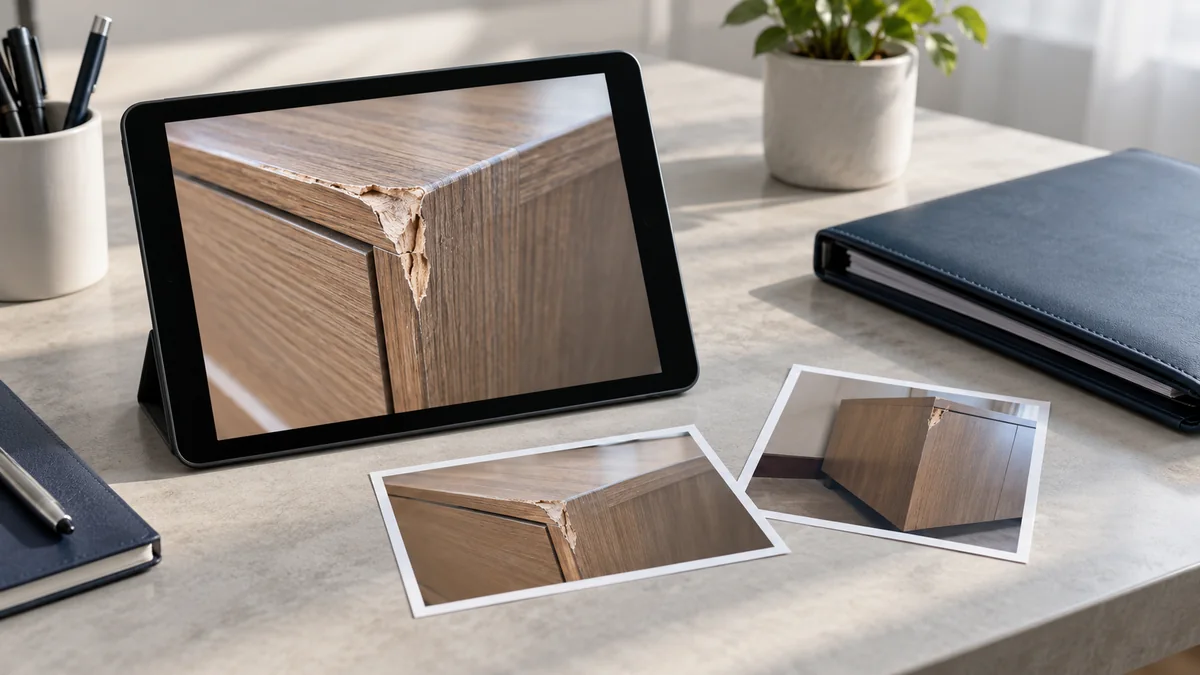
First the question, then the method of examination
Photos and documents can serve as source materials for an examination, but promising a full answer to any question based on them in advance is incorrect. It is necessary to determine which fact needs to be established, which signs are required for this, and whether they are present in the available materials.
For example, in a high-quality image, one can see the location of upholstery tears or changes in the shape of a part. And the strength of a joint, the composition of the material, moisture inside the structure, or the operability of a mechanism may require inspection, measurements, sampling, or testing. Visually similar damage can have different causes.
Preliminary study of the materials helps to agree on the task and the composition of the materials. It does not in itself mean that the investigation has already been conducted or a conclusion prepared. The outcome, scope of work, and limitations need to be determined separately.
When the materials are especially useful
- It is necessary to figure out which signs are visible in the images and what information is still missing.
- It is required to compare the condition at several stages: upon delivery, after assembly, after the damage is discovered.
- The object has changed, been repaired, or lost, but the condition at the required date has been preserved in the materials.
- Another conclusion is being studied: its source data, study description, illustrations, and the logic of conclusions.
- It is necessary to prepare questions and a list of documents before the in-person examination.
The absence of the object does not automatically make the study impossible. But it limits the available checks. For each answer, it is necessary to separately assess whether there is enough documented evidence and how justified the conclusion can be.
Which photographs to prepare
A general view, product identification, medium shot showing the location of the damage, and close-ups are needed. Separate shots from different stages by dates and circumstances. Explain who and when photographed the object and whether its condition changed between the series.
Keep the original files and, if possible, provide them without additional compression. Do not present a screenshot as the original photo. If the shot is obtained from another party and its origin is unknown, explicitly indicate this limitation.
Camera position, lighting, and scale affect the perception of shape, color, and size. From a photograph without sufficient reference, it is not possible to automatically obtain precise measurements. The absence of a visible feature from one angle also does not prove its absence on the entire object.
The detailed procedure for preparing materials is provided in the article on recording a defect before transferring the goods.
Which documents help to connect the information
Prepare documents that allow identifying the item itself and tracing the history of its condition: the order and specification, information about the model and completeness, the manual, documents on delivery and assembly, transfer acts, service requests, results of previous inspections. For damage after flooding, materials about the incident and the subsequent state of the property are important.
It is better to arrange the documents chronologically and make a brief inventory. Indicate where the original is located and where there is a copy or an incomplete fragment. If the documents contradict each other, keep both versions and explain their origin; you should not independently resolve discrepancies in the source files.
For preliminary viewing, personal data can be masked in a separate copy, while keeping the original. Do not delete information from the only copy that may be important for identifying the object and circumstances of the study. It is better to agree on the required contents of the materials before sending a large archive.
What needs to be reflected in the result
When conducting a study based on materials, it should be clear which specific images and documents were used, what is observed on them, how the information is compared, and what limitations were taken into account. It is important to distinguish between an established feature, a hypothesis about its origin, and a fact reported by a dispute participant.
If some features are unavailable, this should be taken into account in the conclusions. Insufficient materials may lead to a request for additional information, a limited response, or a conclusion that it is impossible to resolve a specific issue. A confident answer should not appear solely because the client needs a definitive result.
When appraising the value based on documents, the date of the appraisal, identification of the object, its characteristics, and confirmed condition are discussed separately. To establish the causes of damage, a different set of information may be required than for describing visible changes.
What to write in the first contact
- What goods or property are being examined and where the object is located.
- What question needs to be resolved and to what point in time the relevant condition pertains.
- Is it possible to inspect the object; if not — why, and what has been preserved.
- What changes, repairs, or interventions have already occurred.
- Which photographs, documents, and previous conclusions are available.
You can start with a brief description and a few sample files. For the analysis of an already completed study, there is review of the conclusion. When preparing the assignment, use the section general expert situations, which also presents questions about research without the object.
Discuss your task
Send the description of the item, circumstances, and available materials. After a preliminary review, it is possible to determine the feasibility of the examination, the set of necessary information, and the procedure for work.
Send materials ↗