
Specify which document is in front of you
The conclusion of a judicial expert, a pre-trial specialist report, a quality inspection act, and service diagnostics can address different tasks and be prepared according to different rules. First, clarify the basis for preparing the document, its purpose, the performer, and the questions posed. The title on the cover itself does not determine either the procedural status or the evidentiary significance.
For a judicial examination, applicable procedural requirements are essential. Article 25 of Federal Law No. 73-FZ provides for reflecting objects, materials, content, and results of research, the methods used, and substantiated answers. The applicability of specific requirements to a document should be assessed based on its type and the legal grounds for its preparation.
A practical review of the content helps prepare substantive questions for the specialist. It does not replace a legal assessment of the document and does not mean that any remark makes the conclusion inadmissible.
Step 1. Match the object with the source materials
Check if the analyzed item can be identified: model, labeling, set components, and individual characteristics. Compare the description with photographs, transfer acts, and purchase documents. If only part of the set was examined, the scope of the examination should be clear.
Look at which documents are listed and used, whether a direct inspection was conducted, and what information was obtained from participants' statements. Clarify whether the established condition refers to the date of inspection or if the author is making a conclusion about an earlier period. The latter requires separate justification, especially after repairs or other changes.
Step 2. Read the questions before the final answers
The study must address a specific task. The question of the presence of defects is different from the question of their cause, and the question of the cause is different from determining the impact on value. If several questions are posed, check whether there is an answer to each of them and whether it has not been replaced by an answer on a related topic.
Pay attention to the boundaries of specialized knowledge. A product examination expert examines the characteristics, properties, and condition of a product within their competence. The decision about the guilt of a party, violation of the law, or obligation to return money falls under a legal assessment. For specific technical, chemical, or other tasks, related specialized knowledge may be required.
Formulations can be compared with the bank of questions for the product examination expert. The bank helps to navigate the tasks but does not automatically establish the correctness of questions in a specific examination.
Step 3. Find the connection between the method and the result
In the research section, it is useful to look for the sequence: what was examined or checked, by what method, under what conditions, and what was obtained. A list of standard names does not replace a description of the actions performed. A reference to an instrument by itself does not show what and how it was measured.
If dimensions or other indicators are provided, pay attention to the units of measurement, description of the section, conditions of determination, and the applicability of the compared requirement. For comparison with a standard, it is important whether it relates to the given product, characteristic, and circumstances. You should not independently choose a standard based solely on a similar name.
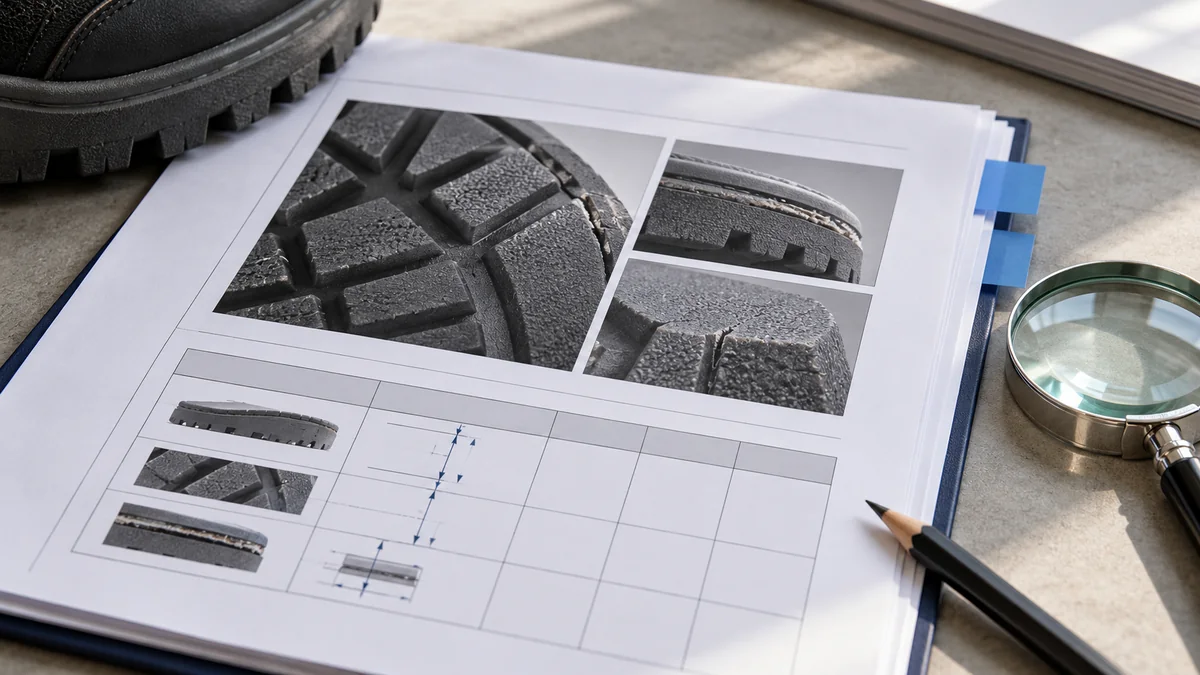
For photographs, check the captions and the reference to the object. The illustration should make it clear which feature is being discussed. A sharp enlargement of a small fragment does not replace the general view, and the color on print or screen does not always allow a confident judgment about color changes of the object.
Step 4. Trace the justification of the reason
The observation "there is a material rupture" and the conclusion "the rupture occurred due to improper use" are on different levels of reasoning. To move to the second, corresponding signs and justification are needed. Look at which alternative explanations were considered and what data support the chosen one.
Indicating traces of use does not always by itself explain the origin of a specific defect. Similarly, the absence of visible external damage does not automatically establish a manufacturing cause. The totality of signs and their connection to the task under investigation are important.
If only photographs are used, compare the categoricalness of the answer with the availability of the necessary signs. The limitations of material analysis are described in a separate article.
Step 5. Compare the conclusions with the investigation
The answers at the end of the document should follow from the presented course of the study. Check whether new facts that are not in the description appear in the conclusions, whether the subject changes, or whether previously named limitations disappear.
A probable answer and the conclusion about the impossibility of solving the question have independent meaning. They should not automatically be perceived as a weakness of the document: they may correctly reflect the lack of initial data. At the same time, the reasons for the limitation should be explained, not replaced with a general disclaimer.
How to prepare remarks for a review
Create a short table: page or fragment, noted issue, related material, and what needs to be clarified. For example: 'On the page with the conclusion, the cause of the damage is indicated; please show which observations and research results confirm it.' Such a record is more useful than the general statement 'the examination is incorrect.'
Submit the complete document with attachments, questions, source materials, and information about what happened with the object. Individual pages may hide an explanation that is located in another part of the conclusion. Technical remarks and procedural actions in the case must be distinguished.
More about the next step: review of the expert opinion and material on challenging the conclusion.
Regulatory source
Federal Law of May 31, 2001 No. 73-FZ 'On State Forensic Expert Activity in the Russian Federation', in particular Articles 8 and 25. The material describes the practical procedure for reading the document and is not a conclusion about the quality of specific expertise.
Discuss your task
Send the description of the item, circumstances, and available materials. After a preliminary review, it is possible to determine the feasibility of the examination, the set of necessary information, and the procedure for work.
Send materials ↗