
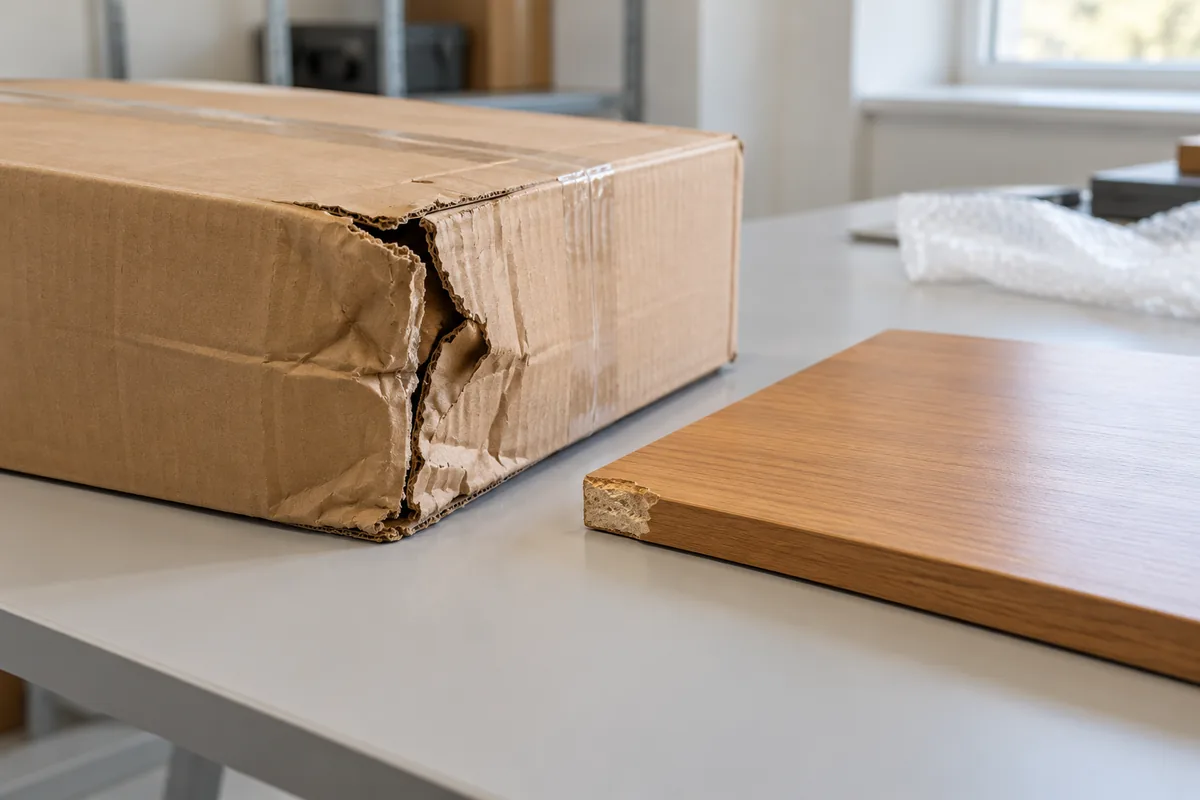
After discovering a chip or deformation, it is important to preserve not only the product itself but also the information about its transfer. The packaging, position of the item, report, and unpacking sequence help investigate the damage. However, a match between the defect of the box and the product still requires checking the mechanism and circumstances of its occurrence.
Safety and state fixation first
Do not use the item if the damage may make it dangerous. Record the overall appearance, the location of the defect, and any available item markings. If the product is already unpacked, describe the actual history rather than staging the original box opening.
What to keep with the item
- Transport and consumer packaging, padding, and fasteners.
- Order, specification, payment and delivery documents.
- Acceptance certificate, damage notes, and correspondence with participants.
- Original photos or videos, if they relate to the shipment.
- Information about movement, assembly, and use after receipt.
Overall view and individual features
First, show which item is being examined and where the damage is located. Then take pictures of the part from several available angles with a scale nearby. A very close-up shot of a chip without context does not allow one to determine whether it belongs to the casing, packaging, or another product.
Packaging is an independent source of information
Mark dents, punctures, signs of wetting, and the condition of protective inserts. Do not remove them until further inspection is agreed upon. The absence of external damage to the box does not rule out all impacts on the goods, and a damaged box does not automatically explain every defect inside.
The position of the item and contact elements may be significant for verifying the claim of transport impact. Therefore, consistent documentation is useful, not just a photo of the item completely removed from its packaging.
Do not repair before documenting
Gluing, touching up, replacing fasteners, and fitting can change the signs. If intervention was necessary, keep the documents and description of actions. For examination, it is important to distinguish the original defect from the consequences of subsequent attempts at correction.
What questions are discussed
It is possible to study the nature of the damage, the technically possible mechanism, the impact on use, and the methods of restoration. Determining the specific responsible person also requires the circumstances of storage and transfer; expert inspection does not replace this history.
For a preliminary request, prepare a short chronology from the order to the discovery of the defect. If the packaging has been discarded or the item has already been assembled, indicate this directly. Preserved materials can still be useful, but missing data should limit the definitiveness of the response, not be reconstructed by assumption.
Materials on the topic
Get a consultation on the topic of the article
What can be sent for primary analysis
- photos of the product or property
- receipt, contract, warranty card
- claim and seller's response
- flood report, service report, or report from another party